
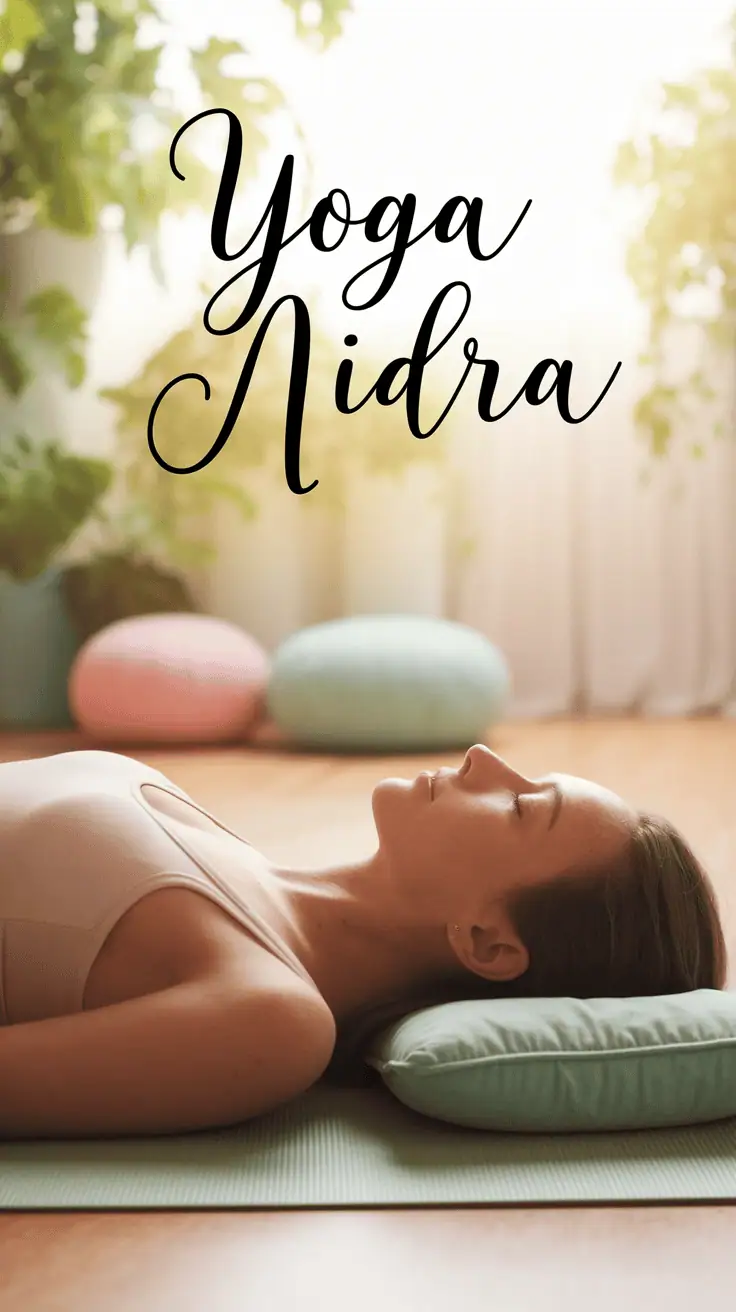
Yoga nidra is a guided relaxation practice done lying down, usually for 10 to 30 minutes. Despite the name, there are no poses. A voice walks you through relaxing your body and settling your attention while you stay on the edge of sleep. Many people use it at bedtime, and some use it as a midday reset.
This guide explains what it is, how to try a simple version tonight, what research says so far, and who should be careful.
Yoga nidra is a low-risk way to practice deep relaxation that may help some people wind down. The research on sleep is early and low in certainty, so treat it as a calming habit to try, not a treatment for insomnia.
What yoga nidra is (and is not)
Yoga nidra is often translated as "yogic sleep." A typical session has you lie on your back and move attention through parts of the body, follow the breath and notice sensations without trying to change them. The goal is to feel deeply relaxed while staying awake or half-awake.
| Yoga nidra | Seated meditation | Gentle yoga | |
|---|---|---|---|
| Position | Lying down | Sitting | Moving through poses |
| Effort | Very little | Sustained attention | Physical |
| Guidance | Usually a recording or teacher | Often self-guided | Teacher or video |
| Falling asleep | Fine | Usually not the aim | Not applicable |
| Best time | Bedtime, or a midday break | Morning or any time | Morning or early evening |
What the research says so far
Yoga nidra has been studied for sleep, stress and mood, and the early results are interesting, but not conclusive. A systematic review and meta-analysis of studies on sleep disturbances and insomnia found potential benefits but rated the certainty of the evidence as very low. The studies were small, varied a lot from one to the next, and some were not randomized. In the randomized trials it included, some measures showed no statistically significant effect.
A fair reading: yoga nidra is a reasonable, low-risk relaxation practice that some people find helpful, and larger, better trials are needed. Broader yoga research has found improvements in sleep quality across studies, but that does not automatically apply to this specific practice.
A 10-minute practice to try tonight
You can do this without an app. Read the steps once, or record yourself reading them slowly, or use a recorded guided session from a reputable teacher or library.
- Get comfortable (1 minute). Lie on your back on your bed or a mat. Use a pillow under your head and knees if it helps. Cover up if you get cold.
- Set an intention (30 seconds). Choose a simple phrase such as "I am settling down." Repeat it once or twice, then let it go.
- Body scan (4 minutes). Move your attention slowly: right hand, arm, shoulder; left hand, arm, shoulder; right foot, leg, hip; left foot, leg, hip; back, belly, chest; neck, jaw, face. Just notice each area. There is no need to force relaxation.
- Breath awareness (3 minutes). Feel your natural breath at the nose or belly. If it helps, count exhales up to ten, then start again. When your mind wanders, gently return.
- Rest (1 minute). Let go of any technique. Stay still for a moment.
- Return (30 seconds). If you are not going straight to sleep, deepen your breath, wiggle your fingers and toes and roll to one side before sitting up.
That is normal. Wandering and returning is the practice. If you feel restless, open your eyes for a moment, shift position or try a shorter session.
Common questions when you start
| Concern | What to try |
|---|---|
| "I fell asleep." | That is fine at bedtime. At midday, set a timer for 10 to 20 minutes. |
| "My mind will not stop." | Do a five-minute to-do list beforehand and start with a shorter body scan. See How to Create a Calming Evening Routine. |
| "Lying still makes me anxious." | Keep your eyes open or focus on your hands and feet, or choose a walking-based practice instead. Stop if it increases distress. |
| "My back or hips hurt." | Put a pillow under your knees, or lie on your side. |
| "I cannot find time." | Do a 5-minute version in bed after your lights are off. |
Where it fits in a bedtime routine
Yoga nidra works well as the last step, after screens are off and the day's loose ends are closed. A simple sequence: dim the lights, take a warm shower, do a few slow stretches from Yoga Poses to Relieve Stress and Boost Flexibility, then lie down for a 10-minute session. For the full routine builder, see Simple Ways to Create a Calming Evening Routine. If you prefer a seated approach, start with Meditation for Beginners.
Who should be careful
- People with a history of trauma or panic. Closing your eyes and turning attention inward can be uncomfortable. Try it with a qualified teacher, keep your eyes open and stop if you feel distressed.
- People who are pregnant. Lying flat on the back can be uncomfortable later in pregnancy. Lie on your side with pillows and check with your provider.
- People with ongoing sleep problems. Relaxation practices are not a substitute for care. Talk to a health care provider if you have trouble sleeping for weeks, snore loudly, wake up gasping or feel very sleepy during the day.
FAQ
Is yoga nidra the same as sleeping?
How long should a session last?
Can I do yoga nidra every night?
Does yoga nidra cure insomnia?
Sources and further reading
- Systematic review and meta-analysis: Effect of yoga nidra on sleep disturbances and insomnia (PubMed)
- A closer look at yoga nidra: early randomized sleep lab investigations (PubMed)
- The effect of yoga on sleep quality and insomnia in women with sleep problems: a systematic review and meta-analysis
- CDC: About Sleep